GoldInvesting
How to Sell Gold for a Fair Price, and Where to Sell It
Selling gold starts with its melt value. Then get written quotes from two or three buyers on the same day, and know when a dealer files Form 1099-B.
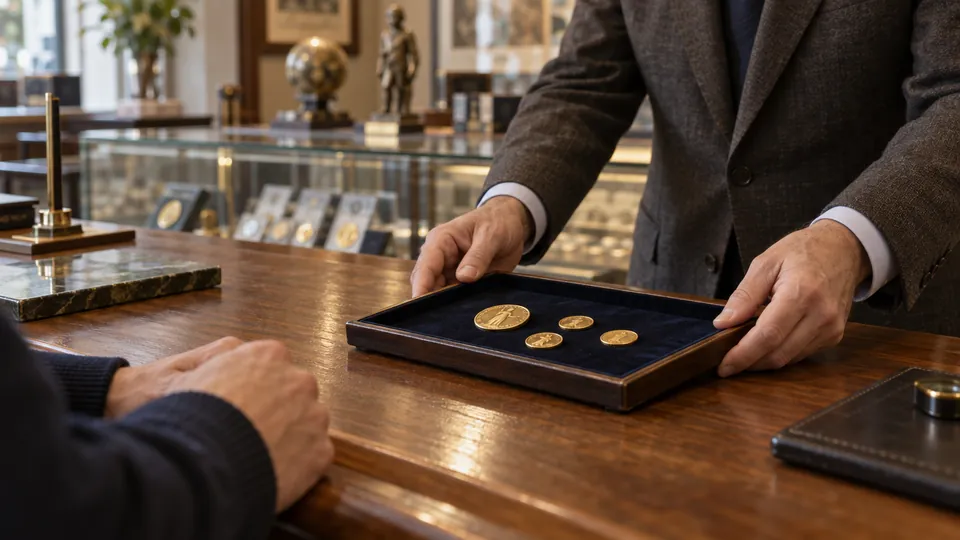
To sell gold, work out what the gold inside it is worth at today's spot price, get written quotes from two or three buyers on the same day, and take the best one after fees. Bullion dealers, coin shops, pawn shops, jewelers, mail-in buyers and refiners all buy gold, and they price it differently. One troy ounce of pure gold is worth today’s spot price at today's spot price. Every offer you get starts from that number.
How much will a gold buyer pay?
Begin with melt value, which is what the pure gold in the piece is worth at today's spot price.
Melt value = weight in troy ounces x purity x spot price.
Bullion coins and bars usually have the gold content stamped on them. The U.S. Mint marks a one-ounce American Gold Eagle "1 Oz. Fine Gold," so its melt value is one ounce times spot. Jewelry is different. You go by the karat mark, and the FTC explains that karats measure gold in 24 parts: an 18-karat piece is 18 parts gold and 6 parts other metal. That makes 18K 75% gold, 14K about 58.3% and 10K about 41.7%.
| Karat mark | Gold content | Pure gold in 10 grams |
|---|---|---|
| 24K | 99.9%+ | 10.0 g |
| 22K | 91.7% | 9.17 g |
| 18K | 75.0% | 7.50 g |
| 14K | 58.3% | 5.83 g |
| 10K | 41.7% | 4.17 g |
A troy ounce is 31.103 grams. Say you've got a 20-gram 14K chain. That's about 11.66 grams of pure gold, or roughly 0.375 troy ounces, so its melt value is about 0.375 times spot. The gold value calculator does the sum for you, and gold karats and purity explains the marks.
 Gold value calculatorAny weight, any karat, at today's spot price.
 Bid versus spot when you sell gold
Spot is the market price for one troy ounce. The bid is what a particular buyer will actually pay you. If the buyer has to test, ship or refine what it takes in, those costs and its margin come out of the bid.
How close the bid gets to melt value turns on what you're selling, so get a separate quote for each kind. Recognized bullion coins and bars carry a stated weight and fineness, which lets a dealer price them straight off spot. Scrap jewelry and dental gold have to be tested and usually refined before the gold can be resold. Collectible coins are their own case: the FTC notes that a historic coin's precious metal value "may be greater or less than its value as a collectible," because rarity and condition also set its price.
You probably paid a premium over spot when you bought. Now you'll receive a bid. The gap between those two is your round-trip cost, and buying gold explains how premiums work.
Where can you sell gold?
| Buyer | Typically buys | What to ask |
|---|---|---|
| Online bullion dealer | Bullion coins and bars | How the price lock works, who pays shipping and insurance, and how many days after arrival you are paid |
| Local coin shop | Coins, bars and often scrap | Its bid per ounce today, how it tests, and whether it pays the same day |
| Jeweler | Jewelry | Whether the offer is for the gold weight only or for the piece as jewelry |
| Pawn shop | Jewelry and coins | Whether the paperwork is a sale or a loan against the item |
| Mail-in gold buyer | Small amounts of scrap | Whether it quotes before melting, how long it holds items, and how you reject an offer |
| Refiner | Larger lots of scrap | Its minimum lot size and its refining and assay charges |
Selling to a bullion dealer
The big online dealers publish a fixed process. APMEX lists five steps: request a quote, lock your price online or by phone, ship using its prepaid and insured labels, have your items verified and authenticated on arrival, and get paid after verification. It says your locked rate holds while your items are in transit.
JM Bullion lets you lock a price online at any hour, then emails mailing instructions and shipping labels. It lists free insured shipping, inspects each item on arrival and pays once the sale is approved. It also asks sellers to "follow the instructions exactly to ensure safe arrival of your products." We'd treat any dealer's packing rules that way.
Selling at a coin shop, jeweler or pawn shop
Walking in means you can watch the testing. Ask each shop to weigh the piece in front of you, tell you the gold content it found, and write down its offer per gram or per ounce. Then go to the next shop.
Pawn shops may also offer a loan with your gold as collateral. If you mean to sell, check that the paperwork says sale.
Selling by mail
Mail-in buyers test what arrives and then make you an offer. That order of events is where people get burned. The FTC told Congress in 2010 that some "cash for gold" marketers "fail to provide consumers with a quote of the value of their precious metal and jewelry before melting it down." Before anything goes in the mail:
- Read how long the buyer holds your items and how you turn down an offer.
- Photograph and weigh every piece, and keep a written list.
- Ship tracked and insured, and keep the receipt.
- Know your melt value so you can judge what comes back.
Getting the best quote
Know your numbers before anyone else names one: weight, purity and melt value at the current gold price. Sort what you have into bullion coins, bars, collectible coins and scrap by karat, because buyers price each group differently.
Get two or three quotes on the same day. Gold moves through the trading day, so Monday's quote and Thursday's quote don't compare. Ask for each offer in writing, as a dollar amount and as a percentage of melt value. Ask what comes off the top, too: shipping, testing, refining or check-cashing fees all shrink what you take home. And find out how and when you'll be paid, with a receipt listing every item.
When a dealer files Form 1099-B
Sometimes. Dealers acting as brokers file Form 1099-B for certain sales, but the IRS Instructions for Form 1099-B carve out precious metals. A sale of gold, silver, platinum or palladium "in any form" for which the Commodity Futures Trading Commission hasn't approved trading by regulated futures contract isn't reportable. Nor is a sale of an approved form in a quantity below the minimum a CFTC-approved contract requires.
The IRS's own example: "a broker selling a single gold coin does not need to file Form 1099-B," even if that coin could be delivered against a futures contract, when all approved contracts for gold coins call for at least 25 coins.
There are two limits. "Sales of precious metals for a single customer during a 24-hour period must be aggregated" and treated as one sale when applying the exception. And the exception doesn't apply if the broker "knows or has reason to know" a customer is breaking up sales to avoid reporting.
Whether your product and quantity is reportable turns on current CFTC-approved contracts, so ask the dealer before you sell, along with what ID it needs from you.
Tax on the gain
Reporting is one question; tax is another. IRS Publication 550 defines collectibles gain as gain from the sale of a "metal (such as gold, silver, and platinum bullion)," as well as coins, held more than one year. IRS Topic 409 says net capital gains from selling collectibles "are taxed at a maximum 28% rate." Held one year or less, the gain is short-term.
Your gain is the sale price minus what you paid, premium included. That's why you hang on to purchase receipts. The gold taxes guide has more, and a tax professional can apply the rules to you.
Selling gold held in an IRA
Gold in a gold IRA sits with the IRA's trustee or custodian, so you arrange a sale through them. IRS Publication 590-B says the coins "must be in the possession of the custodian or trustee of the IRA," and that if the IRA owner takes possession of the coins, "the coins will be treated as distributed." See the gold IRA guide.
Other things sellers ask
Where is the best place to sell gold?
For bullion coins and bars, get bids from an established bullion dealer and a local coin shop. For jewelry and scrap, get written quotes from a jeweler, a coin shop and a refiner or mail-in buyer on the same day, and hold each one up against melt value.
How do I sell gold for the most money?
Work out melt value first, sort by type and karat, get two or three written quotes on the same day, and ask about every fee before you agree to anything.
Do gold buyers pay the spot price?
No. They pay a bid, their own price, which is generally below melt value because it covers testing, refining and their margin. Compare each bid with the melt value you worked out.
Are mail-in gold buyers safe to use?
Some are reputable, but the FTC has flagged buyers that melt gold before quoting. We'd only use one that quotes before melting, lets you reject the offer and get your items back, and ships with tracking and insurance.
Does selling gold get reported to the IRS?
Some sales do. A broker files Form 1099-B only for forms and quantities tied to CFTC-approved futures contracts, and the IRS says a broker selling a single gold coin doesn't need to file. Sales within 24 hours are added together.
How much tax do I pay on gold I sell?
Long-term gains on gold are collectibles gains, taxed at a maximum 28% rate according to the IRS. Gains on gold held one year or less are short-term.
Sources and fact-check10 primary sources, checked October 17, 2026
- IRS: Instructions for Form 1099-B (2026)
- IRS: Topic no. 409, Capital gains and losses
- IRS: Publication 550, Investment Income and Expenses (Collectibles gain or loss)
- IRS: Publication 590-B, Investment in Collectibles
- FTC: FTC Testifies about Consumer Protection Issues Arising from Coins and Precious Metal Investments (September 23, 2010)
- FTC: Prepared Statement on Exploring the Perils of the Precious Metals Market (April 30, 2014)
- FTC: Buying Platinum, Gold, and Silver Jewelry
- United States Mint: Bullion Coin Programs
- APMEX: How to Sell Your Gold
- JM Bullion: Sell to Us
We check every figure against the original source: the mint, the regulator, the exchange or the company itself. Spotted something out of date? Tell us.