GoldInvesting
How a Gold IRA Works, and Which Gold You Can Put in One
A gold IRA is an IRA that owns IRS-approved gold coins and bars, held at a depository. Which gold qualifies, who holds it, how rollovers work and what it costs.
We may be paid when you ask a company named here for information. How we’re paid

A gold IRA is an individual retirement account that owns physical gold coins and bars. The metal has to meet IRS purity rules and sit with a trustee at a depository, not in your house. Most people fund one by moving money from an existing IRA or a former employer's 401(k), and the account then buys the gold for you.
What is a gold IRA?
Legally, it's an ordinary IRA. It's a self-directed IRA under Internal Revenue Code section 408 whose custodian allows physical precious metals, and the rules for the type you pick, traditional or Roth, are the same ones that apply to any other IRA.
What's different is what the account owns. Instead of a fund balance, your statement lists coins and bars, each with a weight and a fineness, stored in your account's name. You'll also hear it called a precious metals IRA, since the same account can hold silver, platinum and palladium that meet their own purity rules. This page sticks to gold.
What a gold IRA actually owns
Through your IRA, you own a beneficial interest in specific metal. The custodian is the legal holder for the account and the depository keeps the metal. Your statement might read "20 one-ounce American Gold Eagles," with a value at the current price. The CFTC and FINRA put it this way: "Metals in an SDIRA must be held by the IRA trustee or custodian," and the custodian sends a statement showing the "melt" value of the metals.
Depositories store it one of two ways. Segregated storage keeps your exact bars and coins apart, and those are the ones you get back. Non-segregated, or pooled, storage keeps your holdings with other clients' identical products, and you get back the same type and quantity. Goldco, for example, lists $100 a year for pooled storage and $150 for segregated. Our gold storage guide explains how depositories work.
Which gold coins and bars qualify for an IRA?
The rule lives in Internal Revenue Code section 408(m). If an IRA buys a "collectible," the IRS treats that amount as if it had been distributed to you, and the law lists "any metal or gem" and "any stamp or coin" as collectibles. Then it carves out two exceptions. Those exceptions are the reason gold IRAs exist.
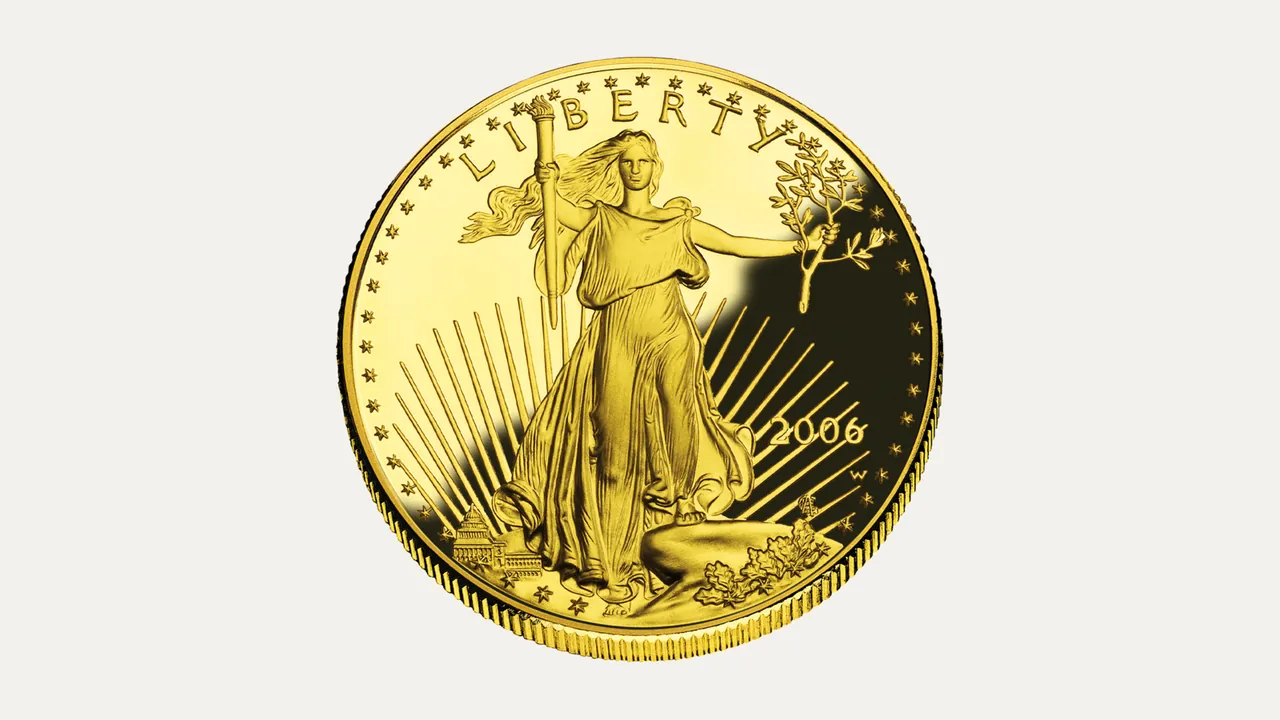
The first is U.S. gold coins described in 31 U.S.C. 5112(a) paragraphs (7) to (10), which are the American Eagle gold coins. IRS Publication 590-A says your IRA can invest in "one, one-half, one-quarter, or one-tenth ounce U.S. gold coins."
The second is gold bullion whose fineness equals or exceeds what a futures exchange requires for delivery on a regulated gold futures contract, as long as it's "in the physical possession of a trustee." For the COMEX gold contract, CME Group's specification says delivered gold "shall assay to a minimum of 995 fineness."
So in practice: the American Eagle qualifies by name, and other gold has to be at least 995 fine. The Eagle gets in even though it sits below that line. The U.S. Mint lists it at 91.67% gold, 3% silver and the balance copper, and a one-ounce Eagle weighs 1.0909 troy ounces in total so that it holds a full ounce of gold.
| Coin | Gold content | Sizes | Why it qualifies |
|---|---|---|---|
| American Gold Eagle | 91.67% | 1, 1/2, 1/4, 1/10 oz | Named in section 408(m)(3)(A) |
| American Gold Buffalo | 99.99% | 1 oz | Fineness above the 995 minimum |
Custodians apply the same line to bars and other gold coins. Equity Trust Company lists gold bars at .995 or finer from manufacturers accredited by exchanges such as NYMEX/COMEX or the LBMA, or from a national mint. It also says coins that have been graded and sealed in plastic ("slabbed") aren't acceptable in its IRAs. There's more on the American Gold Eagle and the American Gold Buffalo in their own guides.
 IRA coin checkerDoes a coin or bar meet the IRS rules for an IRA?
 Dealer, custodian and depository
Three separate businesses do the work. Know which is which and you'll know who to call, and who's charging you what.
| Party | What it does | What it charges |
|---|---|---|
| Gold company (dealer) | Explains the process, helps with paperwork, sells the coins and bars to your IRA, and may buy them back later | The price of the metal, which includes its margin over spot |
| Custodian (trustee) | Opens and administers the IRA, receives the money, pays the dealer on your instruction, keeps records and reports to the IRS | Setup and yearly administration fees |
| Depository | Receives, counts and stores the metal for the custodian, and ships it out when the custodian instructs | Yearly storage fee (often billed through the custodian) |
The law decides who can be custodian. Section 408(a)(2) requires the trustee to be a bank "or such other person" who shows the IRS it will run the account by the rules, and the IRS keeps a list of approved nonbank trustees under Treasury Regulation 1.408-2(e).
A custodian won't pick your gold for you. A joint investor alert from the SEC, NASAA and FINRA notes that self-directed IRA custodians are "only responsible for holding and administering the assets in the account." They don't sell investments, give advice or judge the quality of what you buy. That makes the gold company the one you'll deal with most, and the one worth choosing carefully.
Augusta Precious Metals, the company we refer readers to, names Equity Trust as its preferred custodian and Delaware Depository as its preferred depository.
Opening one in six steps
Six steps, and the gold company handles most of the paperwork with you.
- Choose a gold company. It walks you through the forms and quotes prices for the products you want.
- Open the self-directed IRA with a custodian, traditional or Roth to match the money you're moving. A Roth has to be designated as a Roth when it's opened.
- Fund it, usually by transfer from another IRA or a direct rollover from a former employer's plan (next section). New contributions work too, within the yearly limit, which IRS Publication 590-A sets at $7,500 for 2026 ($8,600 at age 50 or older). Contributions have to be money; you can't contribute coins you already own.
- Pick qualifying coins and bars and agree a price with the dealer.
- Sign a purchase direction. The custodian pays the dealer from your IRA, and the dealer ships the metal to the depository, where it's logged to your account.
- From then on, the custodian sends statements showing your holdings and their value.
Rollover or transfer: the 60-day and once-a-year rules
There are two ways to move retirement money you already have, and the IRS treats them very differently.
Direct trustee-to-trustee transfer (IRA to IRA)
Your current custodian sends the money straight to the new one. Publication 590-A says a transfer "from one trustee directly to another, either at your request or at the trustee's request, isn't a rollover." Since it isn't a rollover, the IRS says the waiting period between rollovers doesn't touch it, and the 60-day deadline doesn't come into it either. This is the usual way to fund a gold IRA from an existing IRA, and it's the one we'd use.
60-day rollover
Here the money is paid to you and you deposit it in the new IRA yourself. That brings in three IRS rules:
- You must generally complete the rollover by the 60th day after the day you receive the distribution.
- You can make only one IRA-to-IRA rollover in any 12-month period, counting all your IRAs together (traditional, Roth and SIMPLE). The 12 months start on the date you receive the distribution. Transfers between trustees and Roth conversions don't count toward this limit.
- Amounts not rolled over within 60 days are treated as a taxable distribution, and the 10% additional tax on early distributions may apply. The IRS can waive the 60-day rule in limited cases, but it can't waive the once-per-year rule.
From a 401(k), 403(b) or 457 plan
Your plan's rules decide when you can move money out, which is often after you leave the employer. Employer plans must offer a direct rollover, paid straight to the IRA's trustee, and the IRS says no tax is withheld from the part paid that way. If the plan pays you instead, it has to withhold 20%, even if you mean to roll the money over. That's why a direct rollover is how most people get gold from a 401(k): the money goes from the plan to the self-directed IRA, and the IRA buys the metal.
| Rule | Direct transfer or direct rollover | 60-day rollover |
|---|---|---|
| Money paid to you | No | Yes |
| 60-day deadline | Does not apply | Applies |
| One per 12 months (IRA to IRA) | Does not apply | Applies |
| 20% withholding from employer plans | None on the amount paid directly | 20% |
What you actually pay
You'll pay a one-time setup fee, a yearly custodian fee for running the account and filing IRS reports, and a yearly storage fee, which can differ for segregated and pooled storage. Then there's the spread: the dealer sells above spot and buys back below what you'd pay to buy, and the gap depends on the product, its size and demand. We'd get every one of those in writing before signing.
Augusta Precious Metals publishes its numbers. It's $50 one time to open, $125 a year administration (custodian) and $100 a year storage. On top of that schedule, Augusta lists ZERO setup, custodian and storage fees for up to 10 years. Shipping and transit insurance are free to all customers, and there's a 100% 7-Day Money-Back Guarantee. Its minimum investment is $50,000.
Run the numbers on a $100,000 rollover. Augusta's published schedule comes to $50 to open and $225 a year after that, and Augusta lists those fees at zero for up to 10 years. For other companies' published figures, see our gold IRA companies comparison.
Each company sets its own minimum
The IRS doesn't set one; each company does. The published figures spread out a lot. Birch Gold Group says $5,000, Noble Gold Investments says $20,000 for its gold IRA, Goldco says it generally requires $25,000, and Augusta Precious Metals' minimum is $50,000.
Can you keep IRA gold at home?
No. The bullion exception in section 408(m)(3) covers metal "in the physical possession of a trustee," and the Tax Court has enforced it. In McNulty v. Commissioner (157 T.C. No. 10, 2021), an IRA owner took American Eagle coins home through an IRA-owned LLC. The court held that was a taxable distribution equal to the coins' cost and upheld accuracy penalties, writing that "Personal control over the IRA assets by the IRA owner is against the very nature of an IRA." Our self-directed IRA guide goes through the case and the prohibited-transaction rules.
Taking cash or coins out
Either way you like. The custodian can sell the metal, usually back to a dealer, and pay you cash. Or it can have the depository ship you the actual coins and bars, which is called a distribution in kind. IRS Publication 590-B describes distributions as "money or other property," so metal paid out in kind counts as a distribution just as cash does.
Publication 590-B also sets the timing:
- Before age 59½, a 10% additional tax generally applies to the taxable part of a distribution from a traditional IRA, "money or other property," unless an exception applies.
- Required minimum distributions from a traditional IRA must begin by April 1 of the year after you reach age 73.
- Roth IRAs have no required minimum distributions while the owner is alive.
Some companies charge for in-kind delivery; Noble Gold Investments, for example, lists a $75 in-kind distribution fee. How a distribution is taxed comes down to your account and situation, so check Publication 590-B and talk to a tax professional. Our gold taxes page has the basics.
What people ask before opening a gold IRA
What is a gold IRA?
A self-directed IRA that holds physical gold meeting IRS rules, stored by a trustee at a depository. It follows the same contribution, rollover and distribution rules as any other IRA of its type.
How does a gold IRA work?
You open a self-directed IRA with a custodian, fund it by transfer or rollover, and choose qualifying coins and bars from a dealer. The custodian pays for them and has them stored at a depository in the account's name.
Is a precious metals IRA the same as a gold IRA?
It's the same account. "Precious metals IRA" just takes in silver, platinum and palladium that meet their own IRS fineness rules.
Can I hold physical gold in my 401(k)?
The usual route is a direct rollover from the 401(k) to a self-directed IRA, which then buys the metal. Your plan's rules decide when you can move money out, so ask the plan administrator.
What is the minimum investment for a gold IRA?
The IRS has none. Companies set their own, from $5,000 (Birch Gold Group's published figure) to $50,000 (Augusta Precious Metals).
Can I move my IRA into gold without paying tax?
IRS Publication 590-A says a direct trustee-to-trustee transfer isn't a distribution to you and isn't limited by the once-per-12-months rollover rule. A 60-day rollover has to be completed on time or it's treated as a distribution.
Sources and fact-check13 primary sources, checked October 17, 2026
- Legal Information Institute: 26 U.S. Code 408, Individual retirement accounts (sections 408(a)(2) and 408(m))
- IRS: Publication 590-A, Contributions to Individual Retirement Arrangements (IRAs)
- IRS: Publication 590-B, Distributions from Individual Retirement Arrangements (IRAs)
- IRS: Approved nonbank trustees and custodians
- CME Group: Gold futures contract specs
- U.S. Mint: Bullion coin programs
- Equity Trust Company: Precious metals IRA
- FINRA, SEC and NASAA: Investor alert, self-directed IRAs and the risk of fraud
- CFTC and FINRA: 10 things to ask before buying physical gold, silver or other metals
- U.S. Tax Court: McNulty v. Commissioner, 157 T.C. No. 10 (2021)
- Birch Gold Group: FAQs
- Noble Gold Investments: Gold IRA
- Goldco: How much does a gold IRA cost?
We check every figure against the original source: the mint, the regulator, the exchange or the company itself. Spotted something out of date? Tell us.