GoldInvesting
What Gold Coins Are Worth, and How to Buy Them
Gold coins are worth their gold content times the spot price, plus a premium. We compare the Eagle, Buffalo, Maple Leaf and Krugerrand before you buy.
We may be paid when you ask a company named here for information. How we’re paid
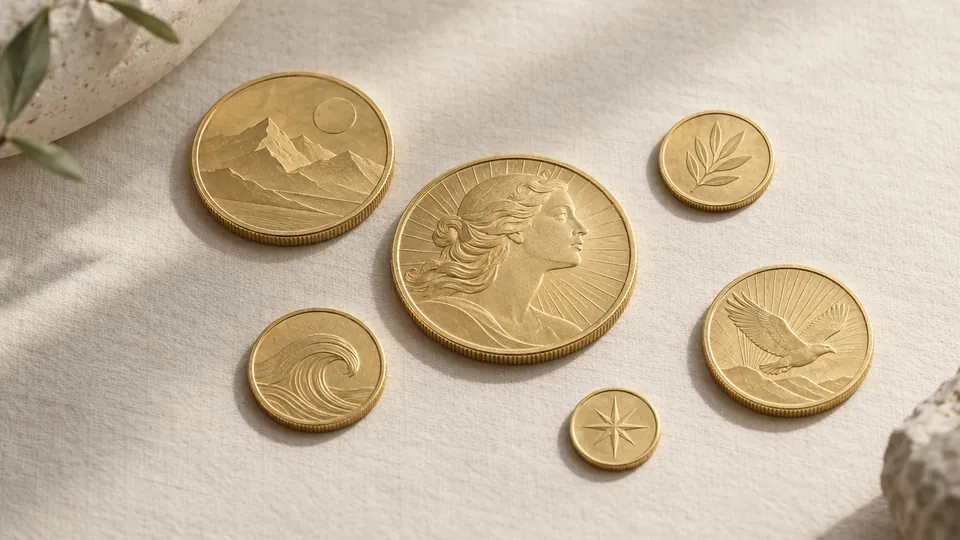
A gold bullion coin is worth the pure gold inside it times the spot price, plus a premium for minting, distribution and the dealer's margin. So a one-ounce coin holds today’s spot price of gold at today's price before that premium goes on. Most American buyers start with one of four: the American Gold Eagle, the American Gold Buffalo, the Canadian Gold Maple Leaf or the South African Krugerrand.
How much is a gold coin worth?
Look at what's stamped on it. A bullion coin carries its fine gold content, such as "1 Oz. Fine Gold" on the American Gold Eagle. Multiply that weight by the spot price and you've got the melt value. One troy ounce is today’s spot price right now; a half-ounce coin holds half that, a quarter-ounce a quarter.
What you pay is melt value plus a premium. The U.S. Mint says bullion coin pricing "typically depends on the market price of the metal, plus a small premium to cover minting, distribution, and marketing costs." Dealers add their own margin on top. When you sell, the dealer's price is tied to the same spot price, which is why the coin's value moves with gold every trading day. The Mint puts it simply: bullion prices "change on a daily basis."
And the $50 on a one-ounce Eagle? That's a legal tender figure. It has nothing to do with what the coin sells for, and the Mint itself calls the face value of its bullion coins "largely symbolic."
 Gold value calculatorAny weight, any karat, at today's spot price.
 How bullion, proof and numismatic gold coins differ
These words describe how a coin is made and priced. They aren't quality grades, and they suit different buyers.
A bullion coin, in the U.S. Mint's words, is "a coin that is valued by its weight in a specific precious metal," with the government guaranteeing its weight, content and purity. Bullion coins are struck in big runs, sold through wholesale distributors and priced off the daily gold price. The Eagle, Buffalo, Maple Leaf and Krugerrand bullion coins all sit here.
Proof is a minting method. The Mint starts with burnished blanks, feeds them by hand into presses with special dies and strikes each coin more than once, which gives frosted images on a mirror-like field. It sells proofs straight to the public at a fixed price, each with a certificate of authenticity. A proof one-ounce Eagle holds the same ounce of gold as the bullion one; its price also reflects the extra work and the limited run.
Numismatic coins are the collector's side. The Mint describes them as coins "valued by limited mintage, rarity, condition, or age." Collector demand and grading set their prices, so they can sit well above melt value or close to it.
| Type | How it is made | How it is priced | Where it is sold |
|---|---|---|---|
| Bullion | Standard strike, large runs | Gold price plus a premium, changes daily | Mint to authorized distributors, then dealers |
| Proof | Burnished blanks, struck more than once | Mint sets a fixed price under its pricing policy | Directly from the mint, then the resale market |
| Numismatic | Varies (often older or limited coins) | Collector demand, rarity, condition | Coin dealers and auctions |
The four bullion coins most buyers see
Four coins make up most of what American buyers see: two from the U.S. Mint, one from the Royal Canadian Mint and one from South Africa. The figures below are each issuer's own, for the one-ounce coin.
| Coin | Issuer | Fineness | Gross weight | Gold content | Diameter | Face value | First year |
|---|---|---|---|---|---|---|---|
| American Gold Eagle | United States Mint | 91.67% (22k) | 33.931 g | 1 troy oz | 32.70 mm | $50 | 1986 |
| American Gold Buffalo | United States Mint | 99.99% (24k) | 31.103 g | 1 troy oz | 32.70 mm | $50 | 2006 |
| Canadian Gold Maple Leaf | Royal Canadian Mint | 99.99% (24k) | 31.11 g | 1 troy oz | 30 mm | $50 (Canadian) | 1979 |
| Krugerrand | Rand Refinery and South African Mint | 91.67% (22k) | 33.930 g | 1 troy oz | 32.69 mm | None in currency (legal tender in South Africa) | 1967 |
The 22-karat coins weigh more. That's the alloy. The U.S. Mint says the Eagle is 91.67% gold, 3% silver and the balance copper; the Krugerrand is 22-karat gold with 1/12 copper. Both still hold exactly one troy ounce of pure gold, and the extra grams are the other metals. The Mint says 22 karat makes a harder coin that resists scratching. A 24-karat coin is softer, but it's almost all gold.
Each coin has its own guide with full specs, design history and fractional sizes: American Gold Eagle, American Gold Buffalo, Canadian Gold Maple Leaf and Krugerrand.
One ounce and the smaller sizes
Most programs offer a one-ounce coin plus smaller "fractional" sizes, which let you own gold in smaller pieces and sell one at a time.
| Coin | 1 oz | 1/2 oz | 1/4 oz | 1/10 oz | 1/20 oz |
|---|---|---|---|---|---|
| American Gold Eagle | Yes | Yes | Yes | Yes | No |
| American Gold Buffalo | Yes | The U.S. Mint's bullion page lists the one-ounce coin only | |||
| Canadian Gold Maple Leaf | Yes | Yes | Yes | Yes | Yes |
| Krugerrand | Yes | Yes | Yes | Yes | No |
A tenth-ounce coin holds 0.1 troy ounce, worth a tenth of today’s spot price before any premium. The gold unit converter handles grams and other units, and our page on what a troy ounce is explains the ounce gold is weighed in.
Why do gold coins cost more than the spot price?
Every coin sells above melt value. Say you're comparing a one-ounce Eagle with ten tenth-ounce Eagles: same gold, different bill. The U.S. Mint publishes what it charges its wholesale buyers for Eagles, the LBMA PM gold price plus:
- 3% for the one-ounce coin
- 5% for the half-ounce
- 7% for the quarter-ounce
- 9% for the tenth-ounce
That's before any dealer adds a margin. The pattern makes sense once you think about it: a tenth-ounce coin takes nearly the same work to strike and package as a one-ounce coin, but holds a tenth of the gold.
Then there's the chain of sellers. The Mint doesn't sell bullion coins to the public. It sells through what it calls "authorized purchasers," who resell to wholesalers, banks and retailers, and each step can add a margin. The Mint lists its current authorized purchasers online and notes that not all of them sell to consumers. Proof and numismatic coins add finish and rarity to the price too.
Retail premiums are set by each seller. We'd compare the total price per ounce of gold, not the sticker on the coin.
 Price over spotSee what a dealer is really charging above the gold price.
 The coins an IRA can hold
Section 408(m) of the Internal Revenue Code treats an IRA's purchase of a "collectible," which includes coins and metals, as a distribution. Section 408(m)(3) then carves out two groups that aren't collectibles:
- Coins named in the statute, including the U.S. gold coins described in 31 U.S.C. 5112(a)(7) to (10). Those paragraphs describe the one, one-half, one-quarter and one-tenth ounce American Gold Eagles, and IRS Publication 590-A says an IRA "can invest in one, one-half, one-quarter, or one-tenth ounce U.S. gold coins."
- Gold bullion "of a fineness equal to or exceeding the minimum fineness" that a regulated futures exchange requires for delivery, held by the IRA trustee. CME Group's COMEX gold futures contract requires gold that assays to "a minimum of 995 fineness."
That's why the Eagle qualifies by name even at 22 karat. The Buffalo and Maple Leaf aren't named, but at 99.99% they clear the 995 line. The Krugerrand isn't named either, and at 91.67% it falls below 995. You can check a specific coin with the gold IRA coin checker; the gold IRA guide covers how the accounts work.
 IRA coin checkerDoes a coin or bar meet the IRS rules for an IRA?
 Buying gold coins, and four answers to get first
Most people buy from a coin dealer, online or in person, because the U.S. Mint only sells bullion through its authorized purchasers. The Mint's own advice is to find "a local or national coin and precious metal dealer that fits your needs." Proof coins are the exception; the Mint sells those directly at fixed prices.
Before paying, we'd get four answers:
- The total price per ounce of gold (divide the price by the coin's gold content so one-ounce and fractional coins compare fairly)
- What the dealer pays when you sell, so you know the spread
- Shipping and insurance, which add to the total
- Where you'll keep the coins, since home, a bank box and a depository each cost something different (see gold storage)
Our guides on how to buy gold and choosing a gold dealer go step by step, and how to spot fake gold covers checking that a coin is genuine.
What else gold coin buyers want to know
How much is a 1 oz gold coin worth?
Its gold is worth the spot price of one troy ounce, today’s spot price today. A dealer charges a premium above that when you buy and pays a price tied to spot when you sell. The gold price page shows the live figure.
Is a gold coin worth its face value?
No. Face value is a legal tender figure. A one-ounce American Gold Eagle says $50, but its market value comes from its gold. The U.S. Mint calls the face value of its bullion coins "largely symbolic."
Are 22 karat gold coins worth less than 24 karat?
Not for the same stated gold content. A one-ounce Eagle (22 karat) and a one-ounce Buffalo (24 karat) each hold one troy ounce of pure gold. The Eagle just weighs more because of the other metals in it.
Where can I buy gold coins?
From coin and precious metal dealers, who get U.S. bullion coins through the Mint's authorized purchasers. The U.S. Mint sells its proof versions to the public directly.
What's the difference between a bullion coin and a proof coin?
A bullion coin is priced off its gold content and the daily gold price. A proof is struck more than once with special dies for a mirror finish, and the mint sells it at a fixed price with a certificate of authenticity.
Do smaller gold coins cost more per ounce?
Yes, as a rule. The U.S. Mint charges its wholesale buyers a 3% premium on one-ounce Eagles and 9% on tenth-ounce coins, and dealer premiums tend to follow the same pattern.
Sources and fact-check13 primary sources, checked October 17, 2026
- United States Mint: Bullion Coin Programs
- United States Mint: Collectible and Investment Coins
- United States Mint: Becoming an Authorized Purchaser
- United States Mint: Authorized Purchasers of United States Mint Bullion
- United States Mint: American Buffalo Coins
- United States Mint: Redesigning the American Eagle Gold and Silver Coins
- Royal Canadian Mint: 2026 Gold Maple Leaf 1 oz bullion coin
- Krugerrand (Rand Refinery and South African Mint): The Real Krugerrand
- Rand Refinery: Products, Krugerrands
- 26 U.S. Code 408(m), Investment in collectibles (Cornell LII)
- 31 U.S. Code 5112, Denominations, specifications, and design of coins (Cornell LII)
- IRS: Publication 590-A, Investment in Collectibles
- CME Group: Gold Futures Contract Specs
We check every figure against the original source: the mint, the regulator, the exchange or the company itself. Spotted something out of date? Tell us.